WEIHSIEN Concentration Camp
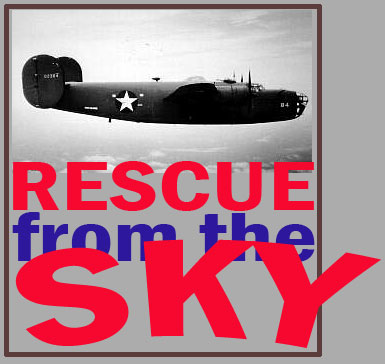
Rescue from the Sky
by Mary Taylor-Previte
Navy Ensign Jim Moore tensed with the rush of adrenalin as the B-24 flew above the Chinese fields. The six-man, American rescue team raced against the clock to prevent the last minute massacre of Allied prisoners -- he shuddered -- the massacre of his school, his teachers by diehard Japanese guards.
Moore had not faced combat before, but today he was electric with the picture swirling in his head. Somewhere beneath the bomber, his own school, his own teachers were now almost within his reach. But for now they were clutched in the bloody hands of Japan. Moore knew too well. Japan had earned its grisly reputation: Rape, enslave, execute civilians. Massacre prisoners. Or prisoners could be kept alive for prisoner swaps, like bargaining chips.
The American rescue team had set out only one day after the Emperor had announced Japan’s surrender. The bomber had started 600 miles away that morning and now circled over fields of ripening broom corn, searching for the “Weihsien Civilian Assembly Center.” Fifteen hundred Allied prisoners were somewhere beneath them. It was 9:30 A.M., Monday, August 17, 1945. Flying at 2,000 feet and armed only with scanty photographs and information, the crew scanned the landscape, trying to locate the camp. They had few clues. They knew only that Allied internees were being held in a Japanese internment camp, a compound somewhere outside a sleepy town called Weihsien (pronounced WAY-shyen).
When the bomber drew no enemy fire, it circled lower in buffeting winds, then lower, hugging the terrain at 500 feet. The drone of the plane posed a frightening provocation for artillery pointed to the sky. The team knew that anything could be in the fields below. Bandits, guerrillas, Chinese communists, Chinese Nationalists, Japanese -- they had all bloodied themselves for this territory.
Amid the horror of atrocities and death camps, feel-good stories still spin out of World War II. In my book, the story of Ensign Jim Moore ranks very near the top. This is the saga of James Walton Moore, Jr., born to a family who believed in miracles. It is the story of his part in the rescue of 1,500 Allied prisoners and the Chefoo School -- his Alma Mater -- imprisoned in the Weihsien Concentration Camp in China.
I was a student in the Chefoo School. I was a child in that camp.
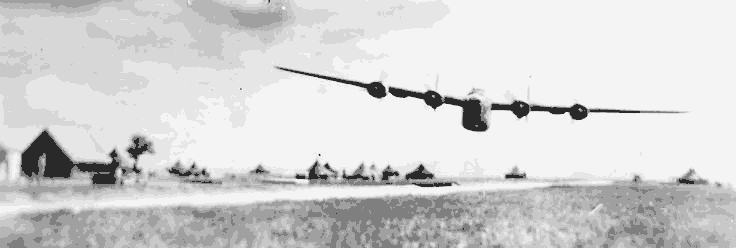
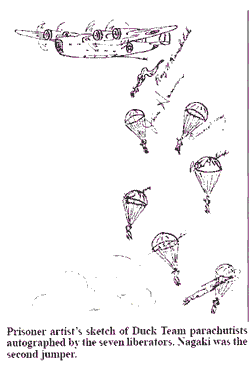
They were spilling from the belly of a low-flying plane, dangling from parachutes that looked like giant silk poppies, dropping into the gao liang (broom corn) fields beyond the barrier walls. August 17, 1945. Every former Weihsien prisoner can tell you exactly where he was that sweltering August morning when the heroes came. Six Americans parachuting from the sky, dropping from a B-24 “Liberator.”
Jimmy Moore’s parents were Southern Baptist missionaries from East Texas when they settled in Chefoo in China’s Shantung province with Jimmy and his sister, Martha Jane. It was 1920. Jimmy was just a year old ― the family’s first and only son. They lived in a compound just off Mule Road and near the Chefoo School, a boarding school founded in 1881 to educate the children of British and American missionaries. Jimmy started as a day student at the school in 1926. Chefoo teachers taught Bible stories and miracles every day. Every student could scamper to the heavens with endless stories about God’s rescuing His people: Moses delivering God’s children out of captivity into the Promised Land, ravens feeding the hungry prophet Elijah in the wilderness, God’s closing the mouths of lions to protect Daniel in the Lion’s Den. Yes, miracles!
Even after 80 years, Jim Moore still remembers the winters when steamers became icebound in the harbor, and students ice skated on tennis courts near the school. Chefoo (now called Yantai) was a picturesque, seaside city in north east China, tucked between the hills of Shantung Province and the Yellow Sea. At the very proper Chefoo School, students wore uniforms, and missionary teachers expected proper, Victorian-style manners. Teachers were known as “Masters.” Jim remembered his favorites: Masters Gordon Martin, Bruce, Duncan, Chalkley, Welch, Harris, and Houghton. Who could forget teachers like these?
With his classmates, he played Prisoners’ base in the Chefoo School Quad, watched billowy-sailed, wooden junks in the harbor, and challenged the waves in row boats named “Hero ” and “Leander. ” The school always named its row boats from Greek mythology. He took the launch to the white sands of Lighthouse Island across the bay. Long before television or movies came to China, he sat spellbound when Masters Martin and Houghton read Kipling aloud to the boys during lazy winter holidays.
In the Chefoo Boys’ School, Jimmy Moore brought glory in athletics to the Carey team. The school named its teams after pioneer missionaries. William Carey was an English Baptist, long dead, who had pioneered Christian missionary work in India in the early 1800s. Jimmy Moore captained the Carey soccer team and its boating crew. He earned a certificate for swimming five miles. At six feet tall, he starred as a runner. Once famous as the home of Emperor Qin Shi Huang, Chefoo had become an outpost for British business. On Saturdays, Jimmy Moore and his teachers played the city’s foreign business team in cricket and soccer.
He was 16 years old when he passed his junior Oxford exams in Chefoo in 1936, opening the door to Hardin-Simmons University in Abilene, Texas. There, he earned his B.S. and met Pat, the woman he would later marry.
As the war heated up in Europe, he took a clerk’s job at the F.B.I. in Washington, D.C., and started studying law at night. A few months before Japan attacked Pearl Harbor, he married Pat.
Then he read the horror: A carefully-worded story in his alumni magazine said his Chefoo School had been captured, imprisoned in Japanese hands.
By now he was Special Agent James Moore of the F.B.I. He and Pat had two babies. On assignment, he searched for draft-dodgers and fugitives, chased down rumors of German agents in California. Yet something else kept hammering on his mind: Teachers and students in his beloved Chefoo School had been marched and shipped and trucked in lorries to the Weihsien Concentration Camp. He could picture it all ― Japanese troops rampaging through the countryside, executing civilians, massacring prisoners. In his mind he could see a kaleidoscope of terror ― little children, his teachers locked up behind barbed wire and walls ― school children, bayonet drills, guard dogs, prisoner numbers, roll calls.
Home and whatever else that was dearest to him were still dear, but this horror was pushing them into the background. It was a daily tug of war. In Washington, J. Edgar Hoover preached security ― said F.B.I. agents had important jobs to do to protect America without facing the guns overseas.
So why did Jim Moore choose to go to war?
You read the school’s alumni magazine, Moore says today, lists of classmates who have died in the war. You read the news ― your school ― your Alma Mater ― marched into concentration camp. You could see it in your head. Your teachers, the little brothers and sisters of your classmates ― little children who looked for “cats’ eyes” shells at the beach where you had played, little children who panted and puffed up Adam’s Knob where you once climbed in the hills behind the city ― little children, all of them prisoners.
“He HAD to go...WANTED to go,” says Pat, his wife. She was terrified to have him leave and frustrated that her husband wanted to go when he didn’t have to. None of it made sense to her.
Moore heard that the super-secret Office of Strategic Services (O.S.S.) was looking for people with a China background. He could speak Chinese, the language of his childhood. Jim Moore resigned from the F.B.I. When the O.S.S. let him choose an Army or a Navy commission, he chose the Navy because its $6 per diem gave him more to send home to his wife and children. He would go to China. A new thought took root in his mind. He would sign on for the rescue mission.
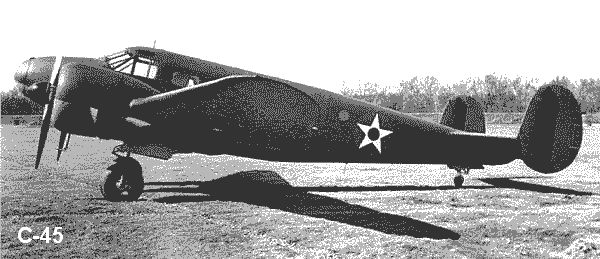
Back home in Texas, Pat Moore worried. “The high point of my day was going to the mailbox,” she says. “I didn’t know where Jim was or what he was doing. I’d send him pictures, keep him up to date about the children.” Trained to keep secrets, Jim rarely wrote.

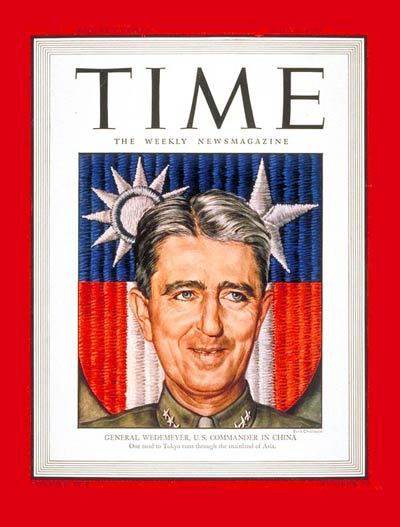
If you knew the Japanese, you knew these rescue missions might be death traps. Moore asked the rescue and development branch to cut down cavalry boots and to convert his .38 belt holster for the left side. He would be ready.
Heading for Japanese prison camps, Americans threw nine rescue missions together at the last minute, all under code names of birds: Magpie (heading to Peiping), Duck (Weihsien), Flamingo (Harbin), Cardinal (Mukden), Sparrow (Shanghai), Quail (Hanoi), Pigeon (Hainan Island), Raven (Vientiane, Laos), Eagle (Korea). The 14th Air Force was ordered to provide the necessary staging areas.
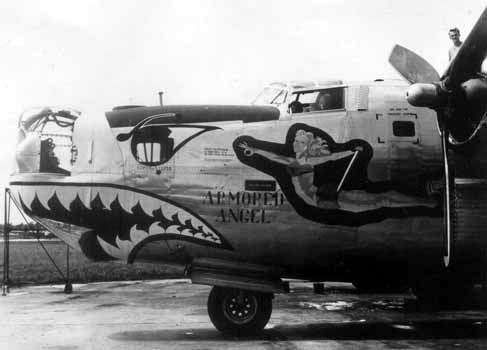
Yes, the war was over and they were flying into Japanese-held territory to locate and rescue Allied prisoners― a humanitarian mission. But would Japanese in these outposts know that Japan had surrendered? Would it be peace? Or would it be guns bristling like needles, pointing at the sky? Twenty-four years old, Moore itched for action. He had been sitting around Kunming way too long. His Chefoo School, his teachers were beneath them on the ground, somewhere hidden in the unending panorama of villages and fields of ripening grain.
The pilot had trouble locating the camp. They circled. Then―
“There it is.” Moore jabbed his finger towards a walled compound tucked among the fields, crowds of people waving hands, waving clothing at the American plane. A small air strip stretched across a field not far beyond the camp. Should they land the bomber? Was the air strip mined? Should they jump?
Team commander, Major Stanley Staiger made the decision: If the worst came to worst, he said, you lose fewer men and less equipment if you jump. By dropping lower, you give the Japanese less space to shoot you and your parachutes.
It was a miserable day and the plane, ill-designed for a parachute drop. To prepare the bomber for the drop, someone had removed panels from the bomb bay door and closed the hole with a makeshift plywood cover. The B-24 now hugged the ground at a gut-wrenching 500 feet. The rescue team sat poised on the edge of the makeshift opening. With a small push, Moore was on his way. Strong winds buffeted the fast-opening British parachutes.
Mary’s Story
Nineteen forty-five had brought a sweltering summer to the camp, now awash in every kind of misery ― plagues of rats, flies, bed bugs. Our Chefoo School teachers organized us children into competing teams of fly killers, teams of rat killers. With food supplies dwindling, teachers sent us foraging for weeds to eat. Some prisoners had lost 100 lbs.
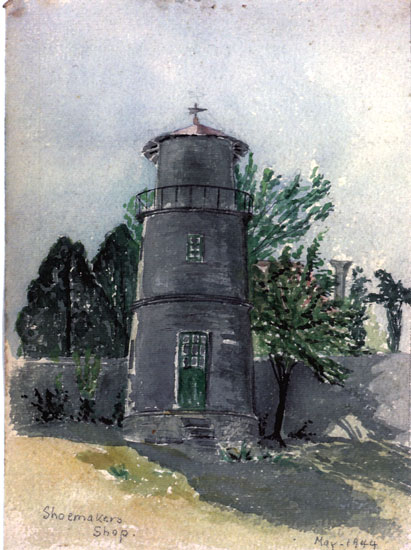
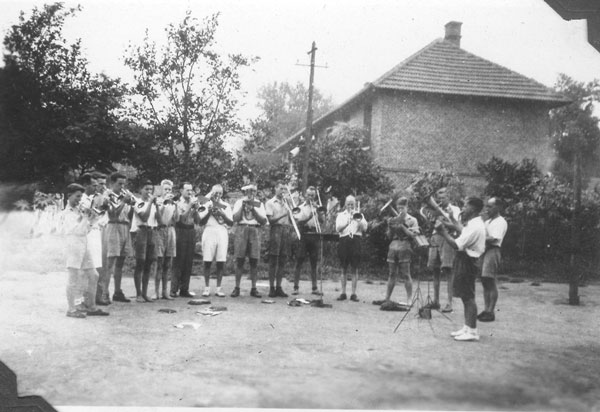
The Salvation Army had guts. Right under the noses of the Japanese, Brig. Stranks and his 15 brass instruments practiced their parts of the Victory Medley each week, sandwiching it between
In 1939, with so much turmoil around us before the war started ― starvation, anxiety, distrust ― Mother was determined to fill us children with faith and trust in God’s promises. But how do you anchor children for the storms of war? The school teacher in her decided that the best way to do this was to put the Psalms to music and sing them every day. So with gunboats in the Chefoo harbor in front of our house, and with Chinese guerrillas limping behind us, bloodied from their night time skirmishes with Japanese invaders, we sang Psalm 91 and Mother’s music at our family worship every morning. We learned the psalm “by heart”:
“Thou shalt not be afraid...He shall give His ANGELS charge over thee to keep thee....”
Like a needle stuck in a gramophone record, the words kept playing in my head:
“He shall give His ANGELS charge over thee to keep thee....”
Angels, angels, angels.
In 1939, Mummy and Daddy had returned to their far away missionary service in northwest China. Now, separated from them by warring armies, Jamie, Johnnie, Kathleen and I had not seen Daddy and Mummy for five and a half years.
It was Friday, August 17, 1945. In a scorching heat wave, I was withering with diarrhea, confined to my “poo-gai” mattress atop three side-by-side steamer trunks in the second floor hospital dormitory. Inside the barrier walls of the concentration camp, I heard the drone of an airplane far above the camp. Sweaty and barefoot, I raced to the dormitory window and watched a plane sweep lower, slowly lower, and then circle again.
Beyond the tree tops, its belly opened. I gaped in wonder as hot August winds buffeted giant parachutes to the ground.
Angels!
Weihsien went mad. It was instant cure for my diarrhea. I raced for the entry gates and was swept off my feet by the pandemonium. Prisoners ran in circles and pounded the skies with their fists. They wept, cursed, hugged, danced. They cheered themselves hoarse. Very proper grown-ups ripped off their shirts and waved at the B-24 “Liberator” circling overhead. Wave after wave of prisoners swept past Japanese guards into fields beyond the camp.
A mile away we found them ― six Americans ― standing with their weapons ready, surrounded by fields of ripening broom corn. Advancing towards them came a tidal wave of prisoners, intoxicated with joy and free in the open fields. Ragtag, barefoot, and hollow with hunger, they hoisted the American major onto a bony platform of shoulders and carried him back to the camp in triumph.
In the distance near the gate, the music of “Happy Days Are Here Again” drifted out into the fields. It was the Salvation Army band blasting its joyful Victory Medley. When it got to “The Star-Spangled Banner,” the crowd hushed.
“O say, does that star-spangled banner still wave,
O’er the Land of the Free and the Home of the Brave.”
From up on his throne of shoulders, the 27-year-old American major struggled down to a standing salute. Up on a mound by the gate, a young American trombonist in the Salvation Army Band crumpled to the ground and wept. He knew what we all knew. We were free.

The Japanese put down their arms.
Inside the camp, the first person Jim Moore asked to see was his former Chefoo School’s Head Master “Pa” Bruce. In an emotional reunion, Moore, 6 feet tall and wearing cut-down cavalry boots and the khaki uniform of the United States of America, towered over his emaciated head master. There stood Chefoo teacher Gordon Martin, who had played soccer with Moore, and Mr. Houghton, who had played field hockey. There was Mr. Welsh, who had officiated in Chefoo’s intramural games. Steely teachers wept. Chefoo students celebrated. My 12-year-old heart turned somersaults.
Grown prisoners wanted American cigarettes ― their first request. That’s not what we children wanted. We trailed these gorgeous liberators around, begged for their insignia, begged for buttons, begged for their autographs, begged for chewing gum and swapped the sticky wads from mouth to mouth. We begged them to sing the songs of America. They were sun-bronzed American gods with meat on their bones.
“You are my sunshine, my only sunshine;
You make me happy when skies are gray.
You’ll never know, dear, how much I love you.
Please don’t take my sunshine away.”
Back in America, The Associated Press trumpeted the story on August 20, 1945:
“Chungking, China (AP)
American rescue teams parachuted into Japanese-occupied areas at the risk of instant death to bring food, medical aid and encouragement to about 20,000 Allied prisoners of war and civilian internees.... The teams were parachuted down to nine places -- from Manchuria to Indo-China....”
The war was over.
Post script:
After it was over
Late in 1945, Pat Moore learned by reading the local newspaper in Texas that her husband had won the Soldier’s Medal for liberating Weihsien. Today, Jim Moore remains shy of admitting he’s a hero. He says he did what any American would have done.
More than sixty years later, Weihsien prisoners still remember. Hardly a week goes by without former prisoners ― from Australia, New Zealand, England, Belgium, Canada, the U.S.A. ― on an Internet memory board, winging the globe with their memories of that day ― AUGUST 17, 1945 ― FREEDOM DAY, the day the Americans came.
After the war, Jim Moore was assigned to the U. S. State Department and served as American Vice-Consul in Tsingtao and later in Calcutta. In 1950, he returned to the United States and worked for the Central Intelligence Agency until he retired in 1978.
As the decades passed, I could never understand why six Americans would parachute ― defying death ― to rescue 1,500 people they didn’t even know. It was beyond my imagination. I wanted to know these men. I wanted to know what makes an American hero.
In 1997, in a series of miracles and with the help of China-Burma-India Veterans Association, I tracked them down. What words would ever be enough to thank a man who risked his life to give me freedom? Talking to them by telephone, sending them cards -- it didn’t feel like thanks enough to me.
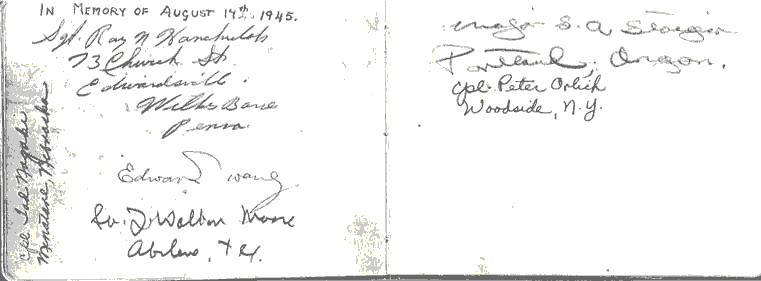
So I started my pilgrimage -- crisscrossing America to visit each one of them face-to-face to honor them ― Jim Moore, Ray Hanchulak, Pete Orlich, Tad Nagaki, Stanley Staiger, Jim Hannon. I went looking for the soul of America. And it is beautiful!
Each one is different: Jimmy Moore, a former FBI agent and the son of missionaries to China. Tad Nagaki, a Japanese-American farm boy who didn’t speak English until he went to school in a small, Nebraska town. Jim Hannon, an adventurer who had prospected for gold in Alaska. Major Stanley Staiger, an ROTC student, snatched from his third year at the University of Oregon. Raymond Hanchulak, a man from the coal mines and ethnic enclaves of Pennsylvania. The youngest of the team ― 21 years old ― Pete Orlich, a kid with a scholarship to college, but whose family needed him to go to work, not go to school ― who memorized the eye chart so he wouldn’t be excluded from the rescue team because he wore glasses. Pete taped his glasses to his head when he parachuted to liberate the Weihsien Concentration Camp that day.
I found them in New York, Nevada, Nebraska, Texas, Pennsylvania, and California.
On holidays I call them on the phone, four heroes and two widows. I send them cards. I call them to say thank you. I often tell their story to school children; the boys and girls send to my heroes hand-made Valentines and hero letters. More than 85 years old now, they all act modest. They say they’re not heroes.
Some folks tell me America has no heroes. They’re wrong. I see the face of heroes in the weathered faces of these six men and the thousands of American men and women who look like them. These are the heroes who saved the world. Yes, America has heroes. I know their names.
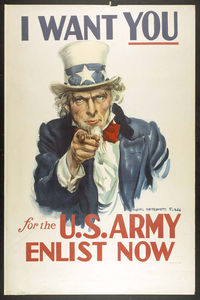
“I Want You” Poster
Catalog #: 1979.0600.06 Accession #: 1979.06
Credit: Armed Forces History, Division of History of Technology, National Museum of American History

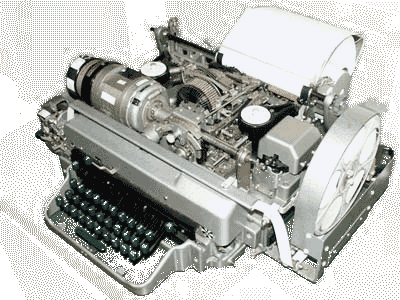
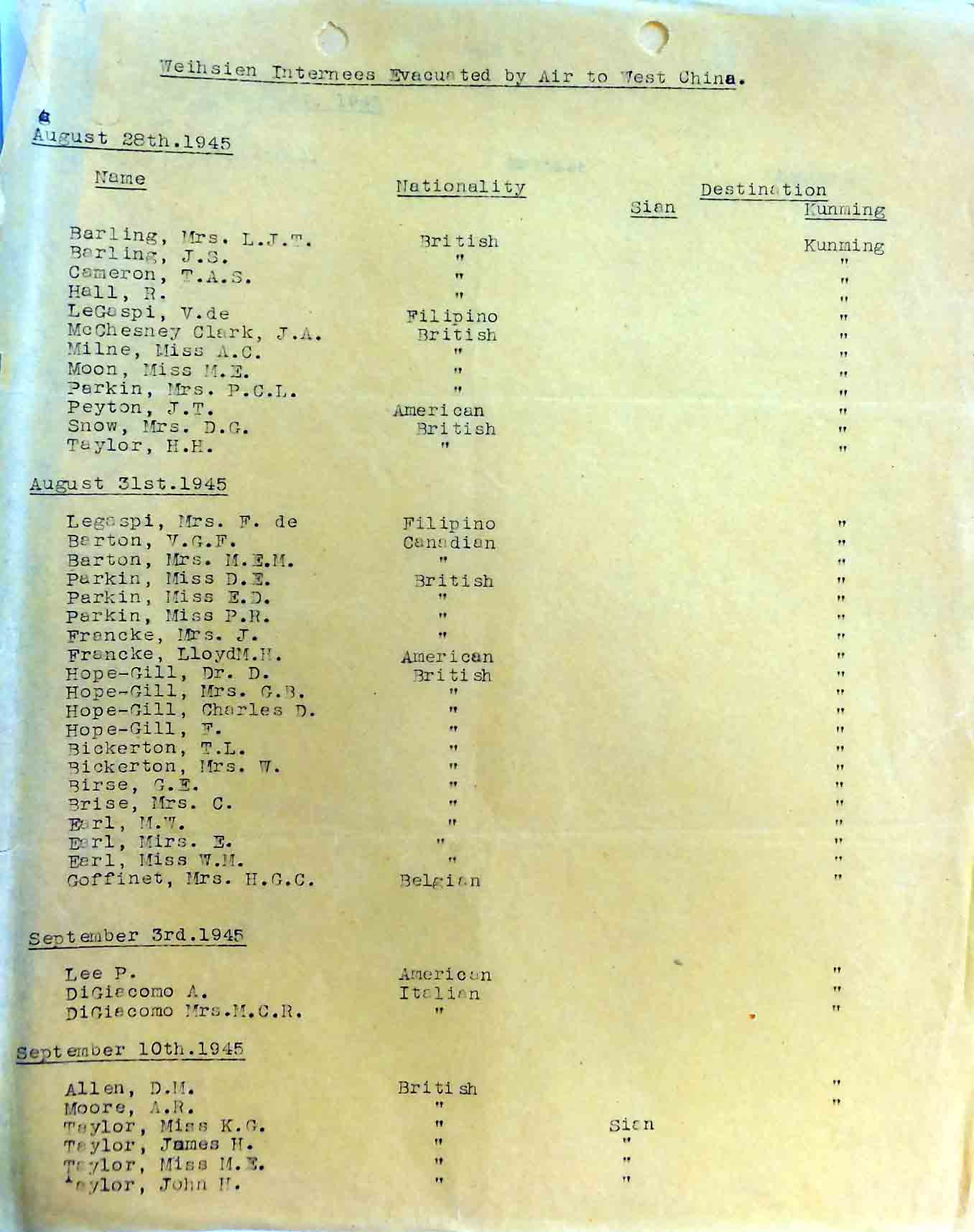
... a declassified telegram/telex from the National Archives sent from Bern in Switzerland.
The War in Europe was over
(May 8, 1945) but in the Pacific aerea the allies were still intensly fighting the Japs.
August 2, 1945 ... the atomic bomb was still TOP SECRET.
The Americans were preparing to leapfrog the Japanese islands in the direction of Tokyo and the U.S.Airforce were constantly bombing all the industrial cities causing thousands of casualties.
On that date, (August 2, 1945) we: (the prisoners of Weihsien Concentration Camp) knew nothing of all that.
[click on the picture]
Weihsien Liberator James Jess Hannon
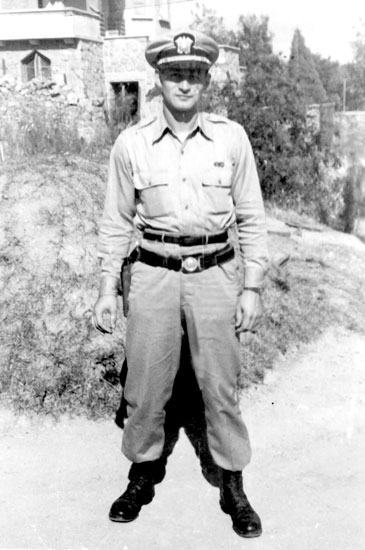
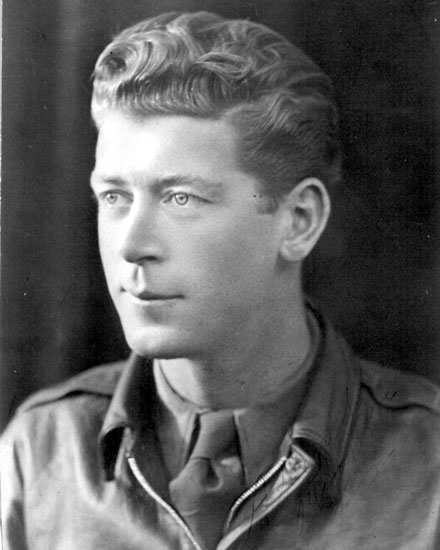
Liberator Ensign Jim Moore
(formerly a student at Chefoo school)
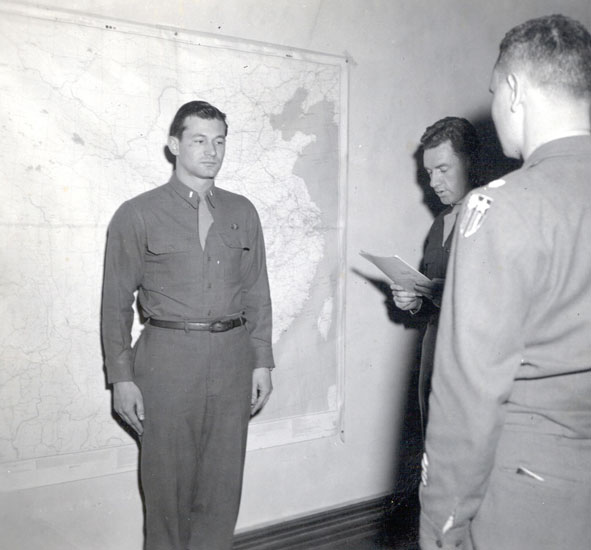
Ensign Jim Moore being awarded soldiers medal for liberating Weihsien.
CITATION
Ensign James W. MOORE, 4450465, USNR, Navy of the United States, is awarded the Soldier's Medal for heroic actions and services performed during the period 17 August to 29 August 1945. As a member of a humanitarian team formed at the request of the Commanding General, United States Forces, China Theater, for the purpose of of locating and repatriating Allied personnel interned in Japanese Prisons in the vicinity of WEIHSIEN, SHANTUNG province, China, this officer was flown deep into enemy territory where he parachuted into the midst of heavily fortified and garrisoned installations. At this time there was no assurance that the American personnel would not receive hostile treatment from the Japanese, yet Ensign MOORE readily accepted these dangers to bring aid to the many Allied prisoners and to assist their early repatriation. By his willingness to risk his life in a gallant effort to bring comfort and assistance to Allied Prisoners of War, this officer performed a service which reflects the highest credit upon himself and upon the Armed Forces of the United States.
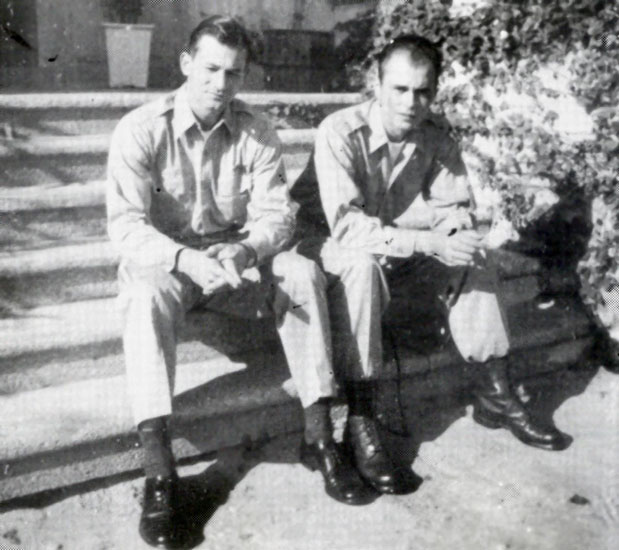
Liberator Ensign Jim Moore and Major Stanley Staiger.
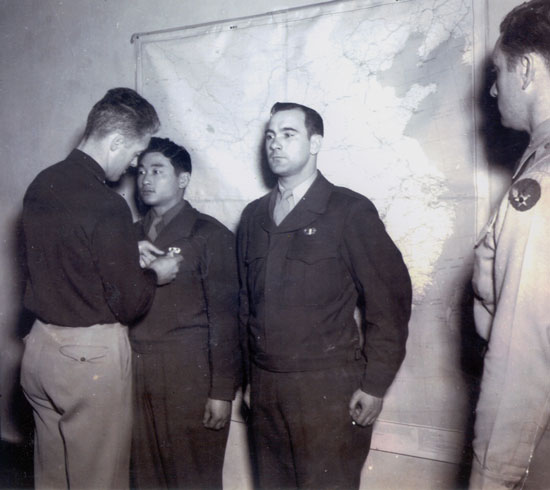
Tad Nagaki, Ray Hanckulak getting soldiers medal
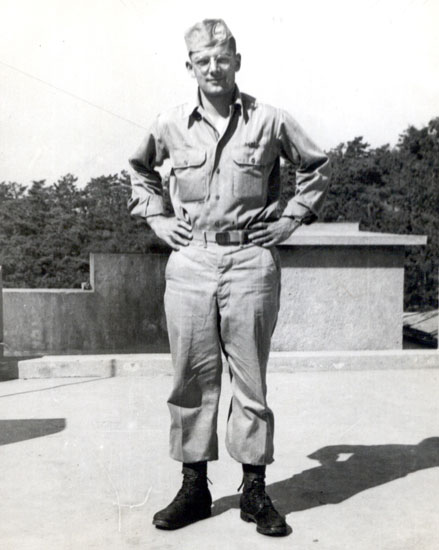
Peter Orlich, radio operator on Weihsien rescue mission.
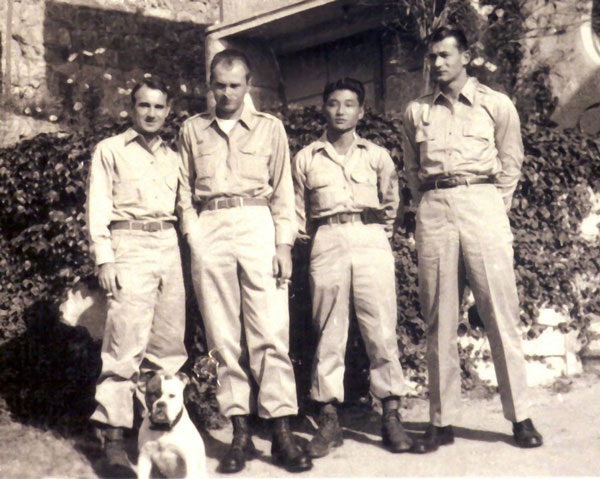
Ray Hanckulak, Stanley Staiger, Tag Nagaki, Jim Moore. Tsingtao, 1945.
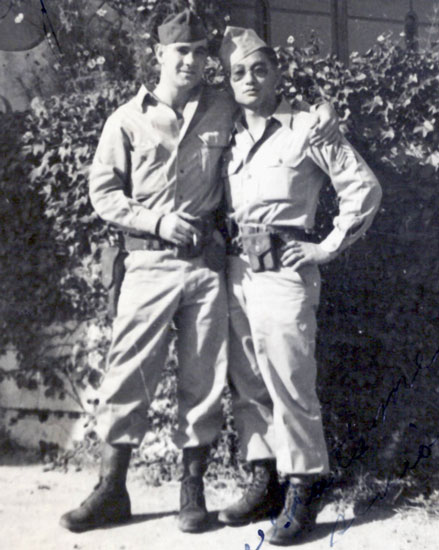
Sgt Raymond Hanckulak and Sgt. Tad Nagaki.
Tsingtao, 1945
.jpg "How Mary finally got in touch with Eddie Wang: [click here]")
Eddie Wang when he graduated ...
Mary Previte, née Taylor 12 years old in 1945. She later became a New Jersey Assemblywoman in the state legislature and searched the U.S.A. to thank -- face to face -- our SEVEN liberators. She roamed the U.S.A. and found SIX of them.
[click here]
It is only very recently that Eddie Wang's grandson located Mary Previte thanks to the "Internet" and the Weihsien-Paintings' website. Eddie Wang lives in China.
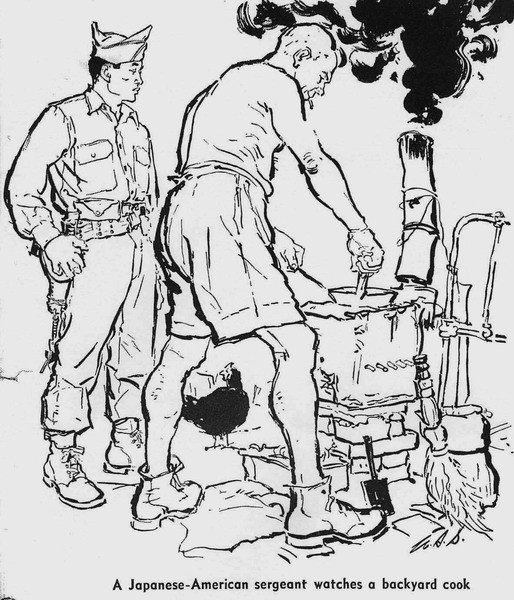
Sgt. Tad Nagaki [click here] watches a backyard cook
by William Smith (war correspondent)
/FiveMarks/JamesJessHannon1945.jpg "[click here]")
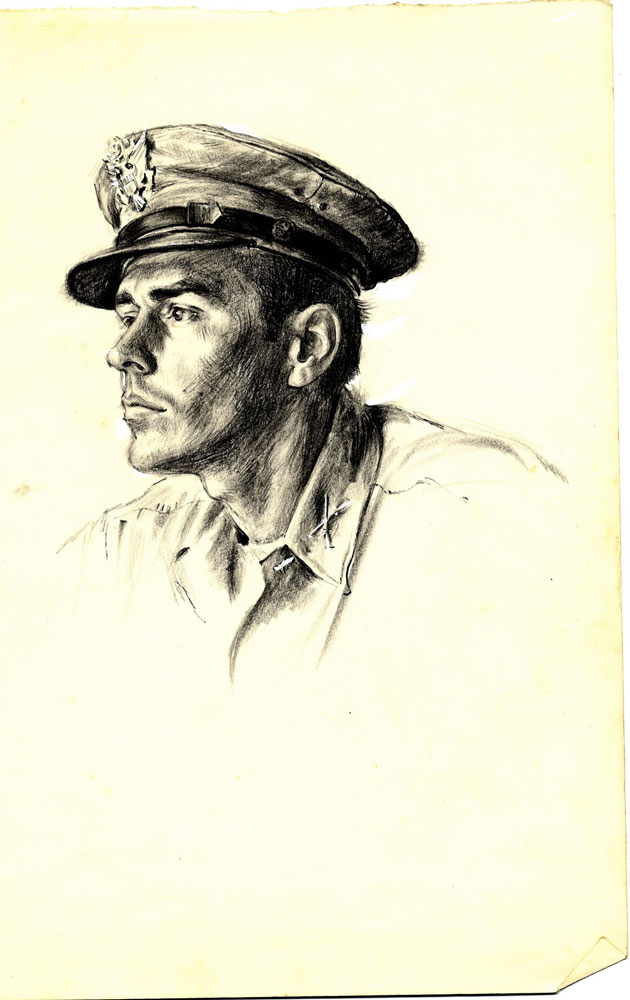
Stanley Staiger sketched by William A. Smith in 1945
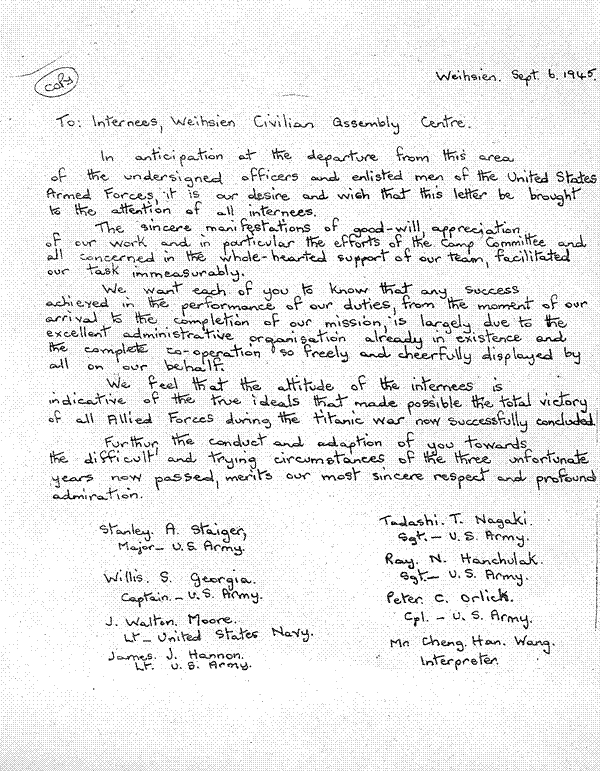
To: Internees,
Weihsien Civil Assembly Centre.
In anticipation of the departure from this area of the undersigned officers and enlisted men of the United States Armed Forces, it is our desire and wish that this letter be brought to the attention of all internees.
The sincere manifestation of good will, appreciation of our work and in particular, the efforts of the Camp Committee and all concerned in the whole-hearted support of our team, facilitated our task immeasurably.
We want each of you to know that any success achieved in the performance of our duties, from the moment of our arrival to the completion of our mission, is largely due to the excellent administration organisation already in existence and the complete cooperation so freely and cheerfully displayed by all on our behalf.
We feel that the attitude of the internees is indicative of the true ideals that made possible the total victory of all Allied Forces during the titanic war now successfully concluded.
Further, the conduct and adaptation of you towards the difficult and tiring circumstances of the three unfortunate years now passed, permits our most sincere respect and profound admiration.
(signed)
Stanley A. Staiger Major U. S. Army
Willis S. Georgia Captain U. S. Army
J. Walton Moore Lt. United States Navy
James J. Hannon Lt. U. S. Army
Tadashi T. Nagaki Sgt. U. S. Army
Raymond N. Hanchulak Sgt. U. S. Army
Peter P. Orlich Cpl. U. S. Army
Cheng Han Wong Interpreter
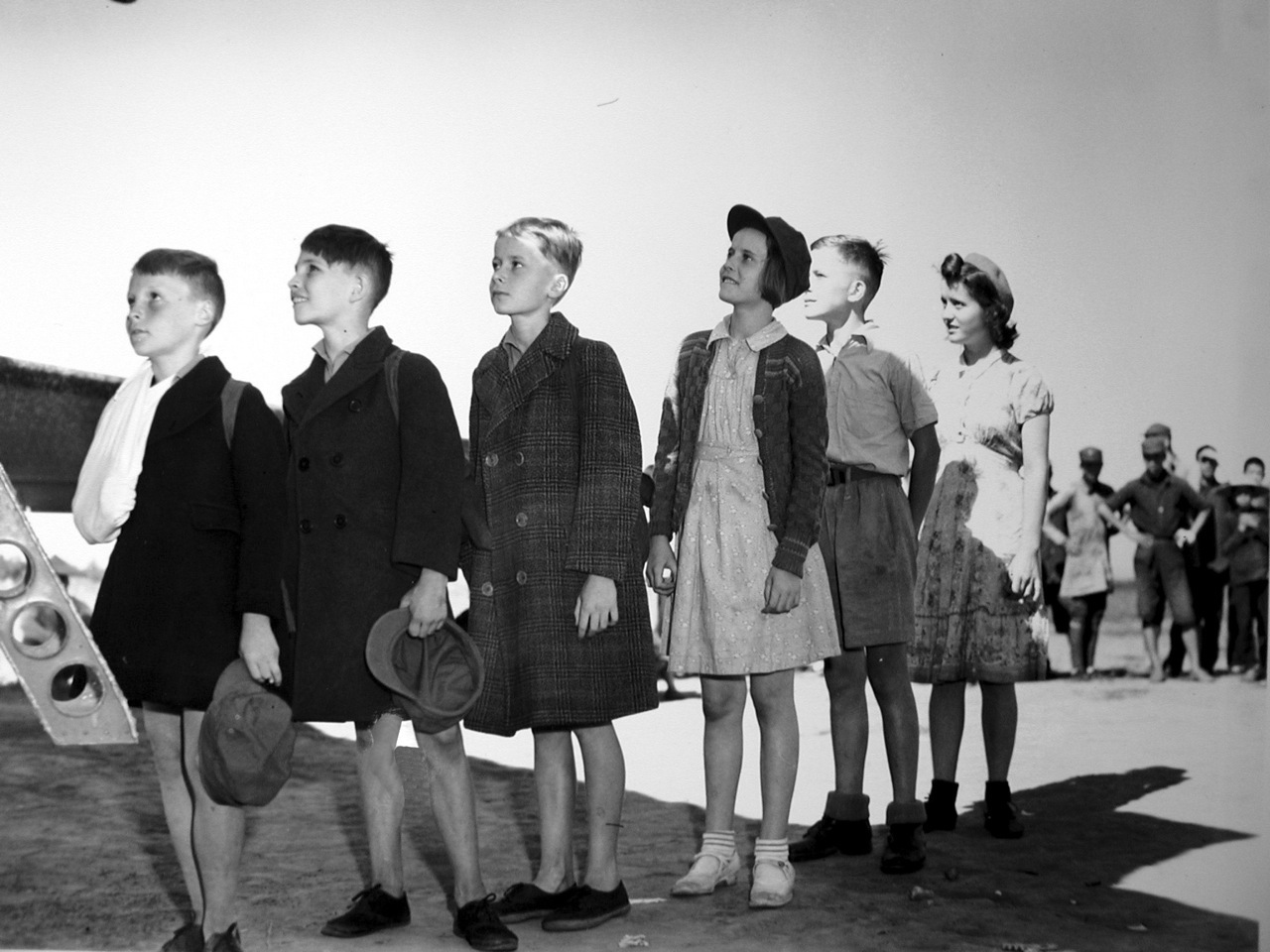
September 10, 1945: Six Chefoo School children lined up to board U. S. cargo plane at Weihsien for flight to OSS base in Si-An: Left to right: Raymond Moore, David Allen, John , Mary, Jamie, Kathleen Taylor.
The four Taylor children were reunited with their parents, Reverend James and Alice Taylor, the next day after a separation of 5 1/2 years. They were also introduced to a little brother, Herbert, , almost 5 years old, whom they had never seen before.
Notice children wearing winter coats in September's heat.
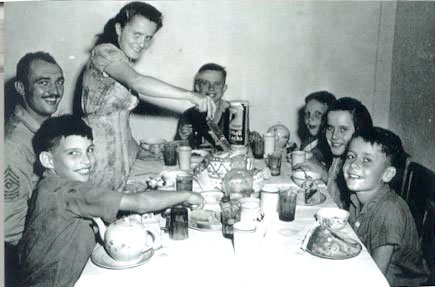
I remember September 10, 1945, the day six of us Chefoo children were flown out of the camp from the air strip beyond the walls -- Raymond Moore, David Allen, and four Taylors -- Kathleen, Jamie, John, and me.
We were only the second planeload out.
For how many weeks the B-24s and the B-29s had been dropping food and clothing into the camp. It seemed so easy. So onto the plane I carried my own tiny relief and memory package to drop to the girls who for almost three years had been my dorm mates in the Lower School Dormitory. Sorrow of sorrows! When the plane got into the air, Weihsien shrank to a tiny, unreachable target beneath us and I don't think the airplane windows opened. I curled up and went to sleep on a heap of used parachutes piled on the floor of the plan. When the plane touched down in Sian, the men at the Office of Strategic Services (OSS) base served us ice cream and cake and showed us a Humphrey Bogart movie . I think it was "Casablanca." Kathleen and I slept that night in an officer's tent -- unaccompanied by bedbugs.
The next night -- 9/11 -- we were home. We hadn't seen our parents for 5 1/2 years.